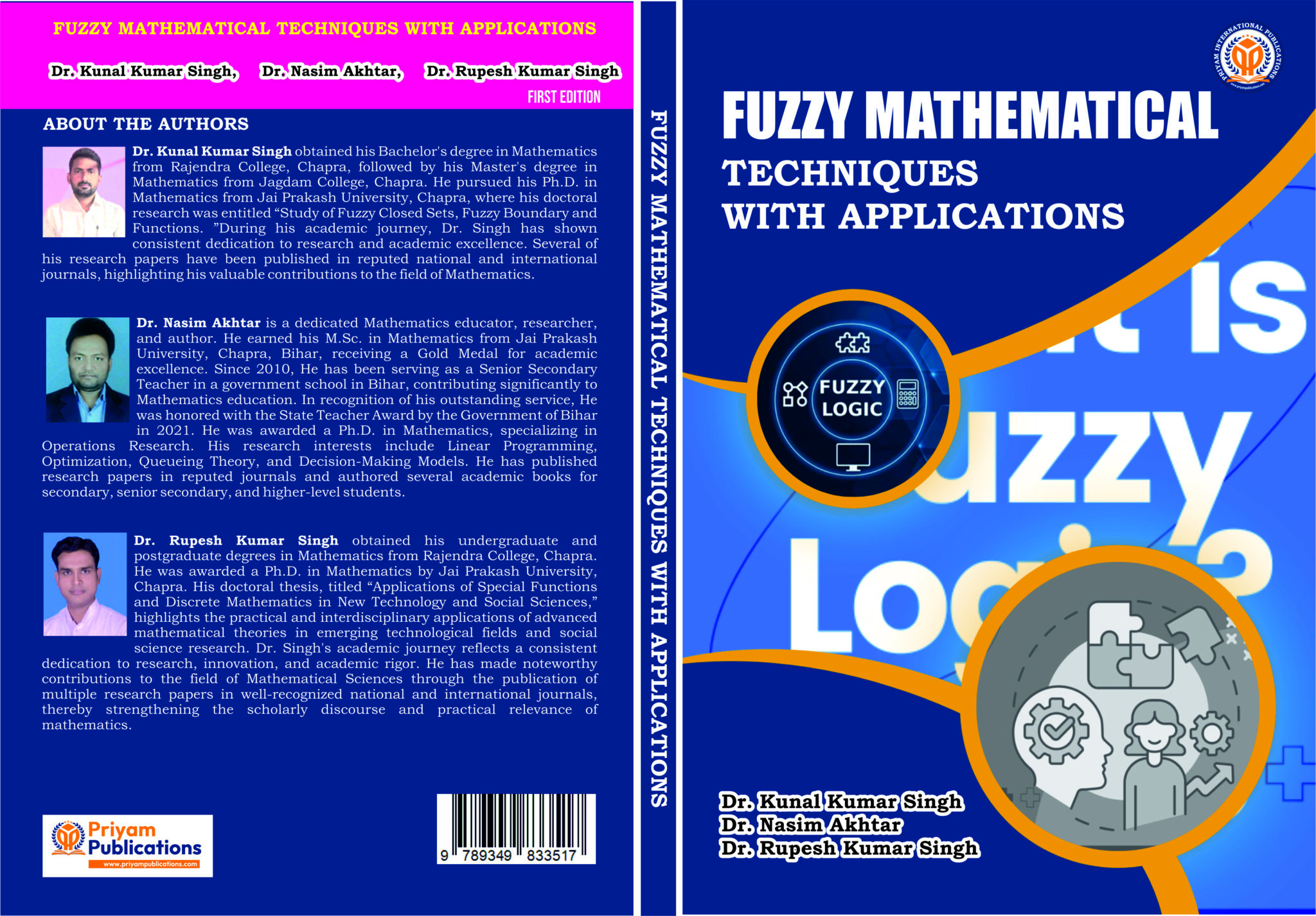
Fuzzy mathematics has emerged as an important field for handling uncertainty, vagueness, and imprecise information in real-world situations. Unlike traditional mathematical approaches that deal with exact values, fuzzy mathematical techniques provide flexible methods for modeling complex systems where ambiguity and partial truth exist. Fuzzy Mathematical Techniques with Applications is designed to provide readers with a comprehensive understanding of fuzzy concepts, methods, and their practical applications across various disciplines. This book explores the fundamental principles of fuzzy mathematics, including fuzzy sets, fuzzy logic, membership functions, fuzzy relations, fuzzy inference systems, and decision-making techniques. It also highlights the applications of fuzzy methods in engineering, computer science, artificial intelligence, business management, medical diagnosis, control systems, and data analysis. The concepts are presented with mathematical explanations, practical examples, and application-oriented approaches to help readers understand both theory and implementation. The purpose of this book is to equip students, researchers, academicians, and professionals with the knowledge and analytical skills required to apply fuzzy mathematical techniques in solving uncertain and complex problems. By combining theoretical foundations with real-world applications, this book aims to encourage innovative thinking, problem-solving abilities, and interdisciplinary learning. It serves as a valuable guide for anyone interested in understanding the growing significance of fuzzy mathematics in modern science and technology.